






-
Intelligence vs. Information: AI transforms raw operational data from connected systems into actionable intelligence rather than just logging history.
-
The Security Multiplier: While AI helps operators and defenders move faster, it also enables attackers to automate reconnaissance, raising the stakes for critical infrastructure security.
-
The Role of Access Control: Secure, identity-based access is the foundation that ensures safe and reliable operations.
In the first two parts of this series, I looked at how Enterprise IT emerged from the convergence of computing and telecommunications, and how Operational Technology became the digital foundation for physical process and controls infrastructure.
Both shifts advanced our civilization in profound ways. Neither, however, is likely to match the speed or the reach of artificial intelligence, which is about to effectively change the nature of our society.
Artificial intelligence is changing the relationship between people, technology, and operations by turning connected systems from sources of information into sources of actionable intelligence.
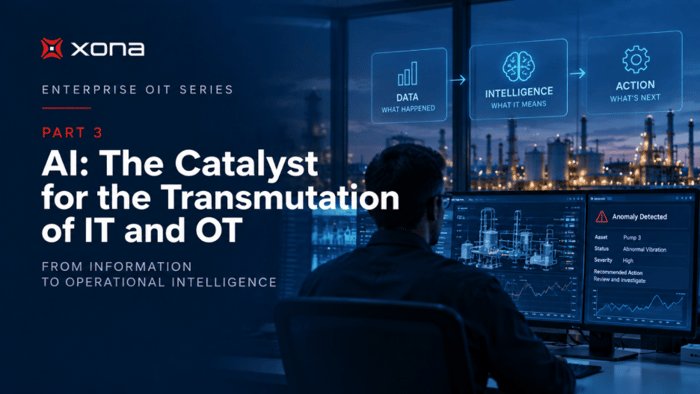
Information tells us what happened. Intelligence helps us understand what it means, what may happen next, and prioritizes where we focus our attention.
Why does more industrial data not automatically lead to better decisions?
Industrial organizations already generate an extraordinary amount of data. Control systems record process conditions. Sensors capture performance data. Maintenance systems track work orders. Security platforms log access and activity. Enterprise applications hold financial, supply chain, and customer information.For years, the challenge was collecting, storing, and making that information available. Digital transformation made that possible. Data could move from the plant floor to enterprise systems, cloud platforms, dashboards, and analytics tools.
Yet more information does not automatically create better decisions.
An operations team can have thousands of alarms, trend lines, maintenance records, and reports, while still struggling to identify what requires immediate attention. A security team can have millions of events, while still needing to determine whether a connection, login, or configuration change represents normal work, an anomaly, or a real threat.
AI identifies patterns across systems, surface anomalies that deserve review, and brings relevant context together much faster than human teams working across disconnected tools. An operator may be able to see that an asset is behaving differently from its normal pattern. A maintenance team may receive a more useful signal about developing issues. A security team may understand not only that a remote user connected, but whether the access was expected, appropriate, and consistent with normal activity.
The value is that it gives people better context for making more accurate and timely decisions.
How is artificial intelligence changing industrial and operational work?
The first wave of digital transformation systems in OT made remote work more practical as control systems and sensors became more digitally connected. AI will evaluate and automate repetitive tasks while reducing time for organizations to understand the health of their industrial operations. AI will eventually make better tactical business and operational decisions and free up time for humans to focus more on strategic planning.Consider a few examples.
An engineer investigating an operational issue may no longer need to spend hours pulling data from separate sources before forming an initial hypothesis. AI can help organize the relevant information, identify similar past events, and point the engineer toward the systems or conditions worth examining.
A field-service team may be able to prepare a visit with a clearer view of the asset’s history, its recent operating behavior, and the specific diagnostics required. A vendor supporting a customer remotely may be able to resolve a problem more quickly because the relevant system data and session history are easier to interpret.
Product development will change as well. AI-assisted development is already reducing the time required to turn an idea into a working prototype. Teams can explore a customer workflow, build an initial interface, and test an approach far more quickly than was possible only a short time ago. That does not eliminate the need for engineering discipline, testing, or security. It does change the speed of iteration, and the expectations customers will have for how quickly technology can adapt to their needs.
Every organization will find different uses for AI. The common thread is that technology will become more active in helping people understand operations and act on what they find. Over time, AI will not only help teams interpret operational information, but also support more automated, context-aware workflows across OT environments.
What are the cybersecurity risks of implementing AI in operational technology (OT)?
AI helps defenders analyze information faster, but it also helps attackers find weaknesses much faster. AI-initiated attacks can identify exposed systems, weak credentials, and overly broad remote-access paths at greater speed. Systems exposed to the internet, unmanaged credentials, and poorly understood connections become more dangerous when adversaries automate reconnaissance. Using Identity-based segmentation and access management reduces OT asset visibility and reduces exposure through granular role and time-based access to authorized systems. Critical infrastructure cannot treat AI as only a productivity story. It is also a security and resilience story.
Artificial intelligence integration in critical infrastructure is fundamentally a security and resilience challenge, because the reliability of AI decisions depends entirely on the integrity of the underlying operational data.
Operational environments are especially important because they increasingly provide the data that AI systems depend on. If operational data is gathered from systems with weak access controls, the decisions built on that data become less trustworthy. A compromised sensor, an unauthorized remote session, or an unnoticed configuration change can have consequences beyond the individual asset. It can affect the intelligence used to make broader business and operational decisions. Trust must therefore become part of the AI conversation.
Organizations need to know who can access critical systems, what they can reach, what they did while connected, and whether that activity fits the work they were authorized to perform. AI makes access control and governance more important because the quality of future decisions will depend on the integrity of the operational environment today.
Secure Access Becomes an Enabler
Some organizations still see strong access controls as a tradeoff against operational speed. In a world where remote work, third-party support, cloud services, and AI-driven analysis are becoming normal parts of operations, that tradeoff is no longer sustainable. The goal is to make connectivity secure and thoughtful. Secure operational access is a method of connecting users to only the specific systems and tasks they require, replacing broad network access with deliberate, identity-based controls.
An employee, contractor, or vendor should be able to reach the specific system they need, for the specific task they are performing, without being given broad access to an entire operational network. Access should be tied to an identity, limited in scope and duration, and visible to the teams responsible for protecting the environment.
That approach does more than reduce risk. It gives organizations the confidence to adopt new operating models. Remote support becomes easier to manage. Operational data can be used more broadly with stronger accountability. AI initiatives can proceed with a clearer understanding of where data comes from and how the underlying systems are protected. Security is not separate from digital transformation. It is what allows digital transformation to continue safely.The Next Technology Change Is About Intelligence
AI will not make IT and OT identical. Industrial systems will continue to have their own safety, reliability, and operational requirements. The distinction between business data and operational data will still matter in many practical ways. AI will drive IT and OT to amalgamate into an automated feedback loop to radically change the model for how organizations think about their technology strategy.AI draws value from both sides. It needs enterprise business context and operational process context. It relies on connected systems, trusted data, and people who understand how those systems affect the real world. It will influence how industrial organizations design products, manage assets, secure remote access, and make decisions.
The next stage of digital transformation will not be defined by how much information an organization can collect. It will be defined by how quickly and accurate it can turn that information into trustworthy and actionable operational intelligence.
In Part 4, the last of our series, I bring the threads together: Enterprise IT, Operational Technology, and AI. The result is not simply a more connected enterprise. It is a more intelligent one.
Connect with the author: Follow Xona Founder and CEO Bill Moore on LinkedIn: https://www.linkedin.com/in/bmoore06/
The Enterprise OIT Series
Part 1: The Evolution of Enterprise IT
Part 2: OT: The Other Technology Evolution
Part 3: AI: The Catalyst for the Transmutation of IT and OT
Part 4: The OIT Enterprise: Where IT, OT, and AI Come Together